Common Bile Duct Surgery & Treatment
Advanced diagnosis and treatment for bile duct stones, biliary obstruction, bile duct injuries and biliary strictures with a specialized hepatobiliary surgical approach.
Common Bile Duct Disorders & Treatment
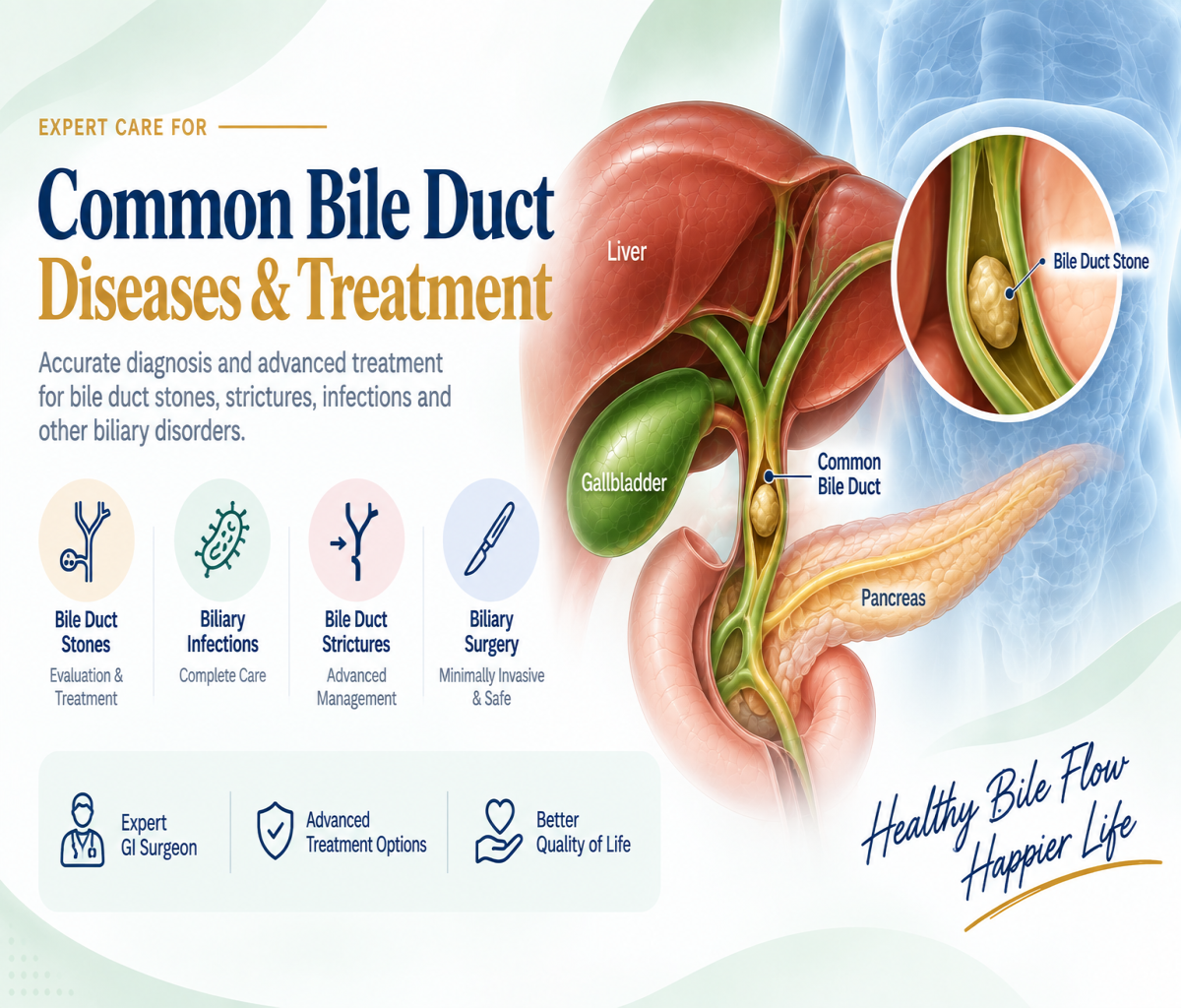
The common bile duct carries bile from the liver and gallbladder toward the intestine. Stones, injuries and strictures can interfere with normal bile flow and may require specialized evaluation and treatment.
What Is the Common Bile Duct?
The Common Bile Duct (CBD) is an important part of the biliary system. It provides a pathway through which bile reaches the intestine.
Problems affecting the CBD can result in abdominal pain, jaundice, fever and other symptoms depending on the underlying condition.
Why Specialized Treatment Matters
Bile duct stones and bile duct injuries can sometimes require more than routine gallbladder treatment.
Depending on the condition, management may involve endoscopic stone removal, laparoscopic exploration, drainage or definitive biliary reconstruction.
Laparoscopic CBD Stone Removal
Common bile duct stones may originate inside the bile duct or migrate from the gallbladder. Most CBD stones are secondary stones that migrate from the gallbladder.
Primary CBD Stones
These stones originate within the common bile duct itself and may require specialized biliary treatment.
Secondary CBD Stones
These stones migrate from the gallbladder into the common bile duct and are more commonly encountered.
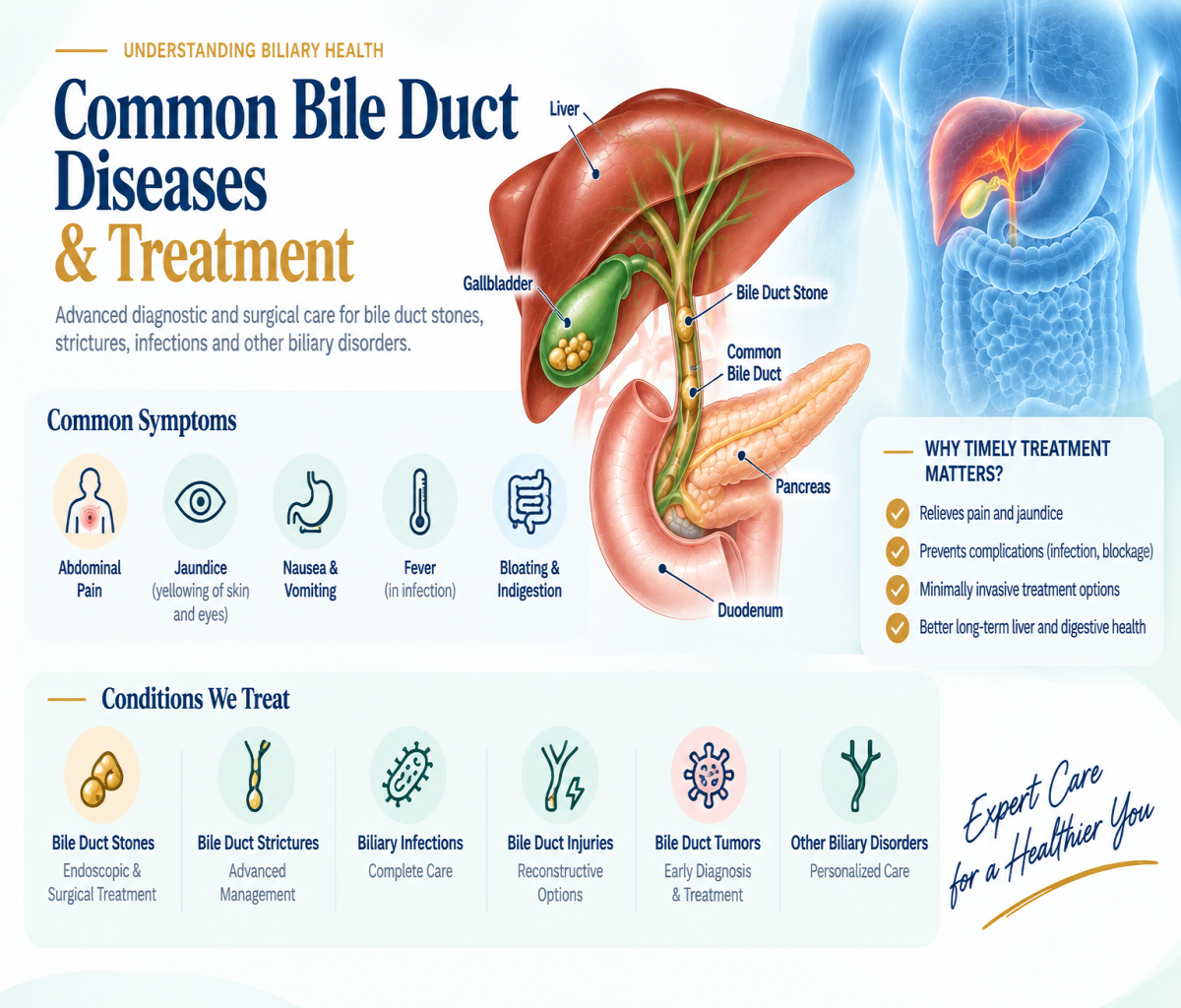
Common Symptoms
- Abdominal pain
- Jaundice
- Fever
Removing Stones From the Bile Duct
CBD stones are commonly treated using endoscopic procedures such as ERCP. Depending on the size and location of the stone, surgical exploration may also be required.
Endoscopic Stone Removal
ERCP can be used to access and remove bile duct stones before or during gallbladder surgery.
Laparoscopic CBD Exploration
Larger or difficult stones that cannot be removed endoscopically may require direct laparoscopic exploration of the bile duct.
Biliary Drainage Procedure
In selected cases, the surgical approach may depend on CBD diameter and the individual biliary anatomy.
When Surgical CBD Exploration Is Required
When endoscopic removal is unsuccessful or not suitable, laparoscopic CBD exploration may provide direct access for stone removal.
Laparoscopic CBD Exploration
Direct removal of stones from the common bile duct through minimally invasive surgery.
CBD > 2 cm
In selected cases with a significantly dilated CBD, choledocho-duodenostomy may be considered.
Smaller CBD
After stone removal, the bile duct may be closed primarily depending on the surgical situation.
Bile Duct Injury & Biliary Stricture
Bile duct injuries most commonly occur during difficult gallbladder surgery, particularly when dense adhesions or abnormal bile duct anatomy are present.
Why Bile Duct Injuries Occur
Difficult anatomy, dense adhesions and challenging gallbladder surgery can increase the risk of injury to the bile duct.
- Difficult cholecystectomy
- Dense adhesions
- Abnormal biliary anatomy
- Complex surgical cases
Management Principles
Management depends on the type and severity of the injury. Complex cases may require referral to a specialized tertiary care center.
- Drain placement in selected early cases
- Definitive surgical repair
- Biliary reconstruction
- Specialized hepatobiliary surgery
Approach to Bile Duct Injury
Early recognition and appropriate referral can be important in managing complex biliary injuries.
Immediate Assessment
If an injury is suspected during surgery, appropriate drainage and assessment may be required when expert repair is not available.
Early Repair
Immediate repair may be possible in selected cases within 48–72 hours when infection is absent.
Delayed Reconstruction
After the early period, delayed definitive repair is often considered according to the patient's condition.
Diagnostic Evaluation of the Biliary System
Imaging helps determine bile duct continuity, obstruction and the extent of a possible bile duct injury.
MRCP
Magnetic Resonance Cholangiopancreatography helps visualize the biliary tree and evaluate biliary continuity.
HIDA Scan
A HIDA scan may be used when the diagnosis remains uncertain and bile leakage needs evaluation.
Ultrasound & CT
Ultrasound and CT can provide additional information regarding the biliary system and surrounding anatomy.
Individualized Biliary Treatment
Treatment is selected according to the cause, location and severity of the biliary problem.
Drainage
Drain placement may be used in selected early bile duct injury cases to control bile leakage.
Definitive Repair
Definitive surgery may be required when the bile duct injury cannot be managed conservatively.
Biliary Reconstruction
Complex injuries may require specialized biliary reconstruction at a tertiary care center.
Dr. Amit Jain
Dr. Amit Jain provides surgical gastroenterology, hepatobiliary and GI oncology care with a focus on advanced minimally invasive and complex abdominal surgical conditions.
Patients with bile duct stones, biliary injuries and complex biliary conditions can be evaluated to determine the most appropriate treatment approach.
Book for AppointmentWhere to Consult Dr. Amit Jain
Consultation services are available at selected locations in Delhi and Greater Noida.
Max Super Speciality Hospital
108A, IP Extension,
Patparganj, Delhi – 110092
Royal Golf Plaza
The Hemisphere, Inside Joyful Smiles Dental Studio,
Greater Noida, Uttar Pradesh – 201310
JM Florence Market
Near Ek Murti Chowk,
Greater Noida West, Uttar Pradesh – 201009
Common Bile Duct Treatment FAQs
Answers to common questions about CBD stones, bile duct injuries, diagnosis and treatment.
Need Evaluation for a Bile Duct Problem?
Get specialist evaluation for CBD stones, biliary obstruction, bile duct injury or biliary stricture and discuss the most appropriate treatment option.
Book for Appointment